Vertical farming Wikipedia
Table of Content
Critics argue years after acquiring acres of land from Detroit, Hantz could sell the property for development into high-end and commercial real-estate. This action would generate massive profits for the Hantz Group while hurting community cohesion and leaving no payoff for long-time residents. Urban agriculture in West Oakland has taken a radical form that can be traced back to community gardening initiatives starting in the 1970s in the cities of Berkeley and Oakland, and the city's African-American heritage.
In this scenario, urban agriculture seems unlikely to be put into practice since it must compete with real estate developers for the access and use of vacant lots. Alternative farming methods have emerged as a response to the scarcity of land, water, and economic resources employed in UPA. In light of these benefits, urban agriculture is growing more common in Australia, particularly in the form of urban farms and roadside gardens. In some cities, local councils have even encouraged urban agriculture by providing residents with guidelines to support roadside gardens. In others, however, planning policies and regulations have impeded access to sufficient and suitable land for urban agriculture.
What to Consider When Choosing the Best Hydroponic System
It is also home to four Western honey bee beehives which pollinate the plants on the roof and provide honey. The living includes other sustainable practices such as recycling and reusing water. Tomato plants growing in a pot farming alongside a small house in New Jersey in fifteen garbage cans filled with soil grew over 700 tomatoes during the summer of 2013.

This is both inconvenient and problematic as the disposal location of this wastewater needs to be carefully considered. Rather than having these problems with a chemical imbalance, aquaponic systems achieve a natural nitrogen balance that is the hallmark of an established eco-system. In aquaponics, you are creating a natural ecosystem where you rely on bacteria and composting red worms to convert the ammonia and solid waste from the fish into a complete plant food. Conversely, if growth hormones or antibiotics are given to the fish, the plants will suffer.
Double Family Garden
With its long-lasting timed LED light, digital display, and multitude of accessories, tools, and seeds, the AeroGarden Harvest Elite is made to keep six plants healthy and happy in the long run. If you are looking for something that can grow more than 12 plants at once, automatically circulates water, and comes with all the accessories you need, we recommend the Moistenland system. Each bucket connects to a central pump that circulates air through the water.
A study showed increased soil fertility following the addition of mature compost to a clay soil. High soil tannin content can cause nitrogen to be sequestered as resistant tannin-protein complexes. The effect of pH on a soil is to remove from the soil or to make available certain ions.
A beginner's guide to hydroponic growing
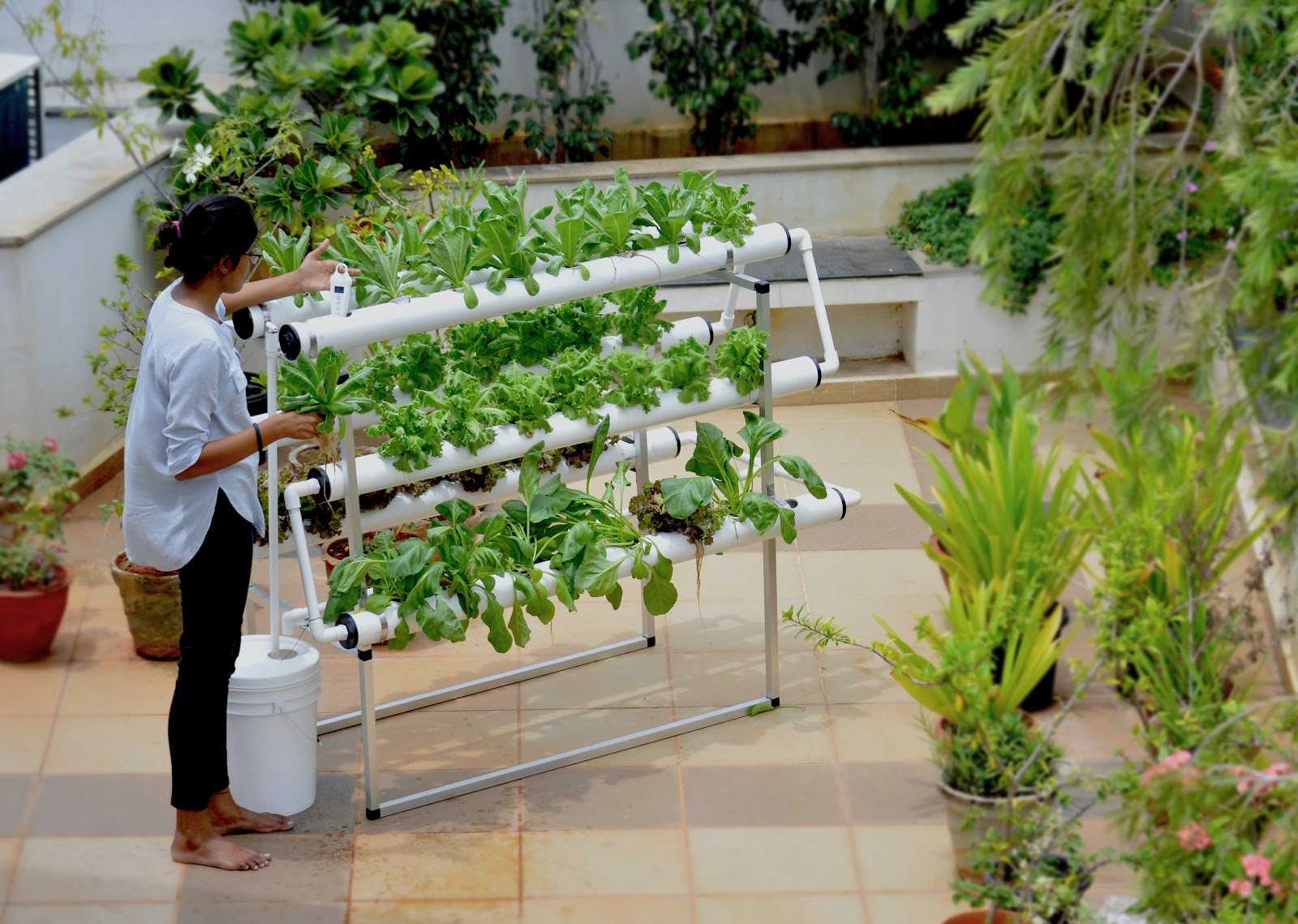
As a consequence, an abundant supply of oxygen is provided to the roots of the plants. A properly designed NFT system is based on using the right channel slope, the right flow rate, and the right channel length. The main advantage of the NFT system over other forms of hydroponics is that the plant roots are exposed to adequate supplies of water, oxygen, and nutrients.
Such "suburban agriculture" led to more than 70% of non-staple food in Beijing, mainly consisting of vegetables and milk, to be produced by the city itself in the 1960s and 1970s. Recently, with relative food security in China, periurban agriculture has led to improvements in the quality of the food available, as opposed to quantity. One of the more recent experiments in urban agriculture is the Modern Agricultural Science Demonstration Park in Xiaotangshan. Canada has a number of companies working on urban farm technology, including in Montreal.
A hardy annual, some varieties of lettuce can be overwintered even in relatively cold climates under a layer of straw, and older, heirloom varieties are often grown in cold frames. Lettuces meant for the cutting of individual leaves are generally planted straight into the garden in thick rows. Heading varieties of lettuces are commonly started in flats, then transplanted to individual spots, usually 20 to 36 cm (7.9 to 14.2 in) apart, in the garden after developing several leaves. Lettuce spaced farther apart receives more sunlight, which improves color and nutrient quantities in the leaves.
It encompasses a complex and diverse mix of food production activities, including fisheries and forestry, in cities in both developed and developing countries. The term also applies to urban area activities of animal husbandry, aquaculture, beekeeping, and horticulture. These activities occur in peri-urban areas as well, although peri-urban agriculture may have different characteristics.
After the disintegration of the Soviet Union and the Eastern Bloc, Cuba faced severe shortages of fuel and agrochemical inputs. These products had previously been imported from the Soviet Union in exchange for Cuban sugar. As a result, Cubans experienced an acute food crisis in the early 1990s, which in part was met with a popular movement of urban agriculture.

Forest ecosystems on these soils rely on efficient recycling of nutrients and plant matter by the living plant and microbial biomass to maintain their productivity, a process which is disturbed by human activities. Excessive slope, in particular in the presence of cultivation for the sake of agriculture, may encourage the erosion of the top layer of soil which holds most of the raw organic material that would otherwise eventually become humus. Plant uptake of nutrients can only proceed when they are present in a plant-available form. Although minerals are the origin of most nutrients, and the bulk of most nutrient elements in the soil is held in crystalline form within primary and secondary minerals, they weather too slowly to support rapid plant growth.
As existing hydroponic and aquaculture farming techniques form the basis of all aquaponic systems, the size, complexity, and types of foods grown in an aquaponic system can vary as much as any system found in either distinct farming discipline. Aquaponics is a food production system that couples aquaculture with hydroponics whereby the nutrient-rich aquaculture water is fed to hydroponically grown plants. Deep water culture allows the roots to grow directly into a nutrient rich water solution. There is a central tank which will house an air pump and recirculating pump, this is where the user will fill the system and make all the relevant checks for P.H, E.C and take water temperature readings. This method of growing uses 80% less water than a typical raised bed and because of this the user will typically get less weed growth as the moisture isn’t there for them to establish, meaning bigger yields for the plants that the user wants to grow. The other advantage is that its hard to over water as the plants take the water they need as they want it.

The disadvantages are that you need electric, it can be an expensive system to set up because of all the pumps and accessories needed, the user must keep an keen eye on the water for nutrient swings and oxygen levels. His successor Henry II, who had also travelled to Italy and had met Leonardo da Vinci, created an Italian nearby at the Château de Blois. Beginning in 1528, King Francis I created new gardens at the Château de Fontainebleau, which featured fountains, parterres, a forest of pine trees brought from Provence, and the first artificial grotto in France.
The most significant is Lufa Farms, a private company that opened what is reported to be the world's largest rooftop greenhouse at 163,000 sq ft in the Montreal borough of Saint-Laurent. This is Lufa's fourth rooftop greenhouse in Montreal and is built on the roof of the former Sears Canada warehouse. Lufa's first rooftop greenhouse was built in early 2011, a 2880 sq metre hydroponic rooftop greenhouse atop a warehouse designated as their headquarters. They built two more large rooftop greenhouses in greater Montreal in 2013 (4,000 sq metre / 43,000 sq ft) and 2017 (5,850 sq metre / 63,000 sq ft), spending almost $10 million for the three structures.
Aquaponics uses 1/10th of the water of soil-based gardening and even less water than hydroponics or recirculating aquaculture. In large scale industrial farming, agrochemicals along with Genetically Modified Organisms are of concern when choosing vegetables, fruits, and herbs. Organically grown crops do not allow GMOs but do have a wide variety of products used for pesticides.


Comments
Post a Comment